At 9:15 on a Monday morning, a finance employee receives a message from a senior executive.
The request looks familiar. The language sounds normal. The timing creates pressure.
The employee is asked to update a supplier’s bank details before an important payment is released.
They have completed security awareness training. They know phishing exists. They know people should be careful with payment requests.
But the situation still feels believable.
The employee is working under a deadline. The request appears to come from someone with authority. The usual contact person is unavailable. Asking too many questions may feel inconvenient or even disrespectful.
This is where human risk actually happens.
It does not happen only when someone ignores a security rule. It happens when people make decisions while dealing with pressure, workload, technology, workplace expectations, trust, urgency, and uncertainty.
This is the problem that AICR is designed to understand.
What is AICR?
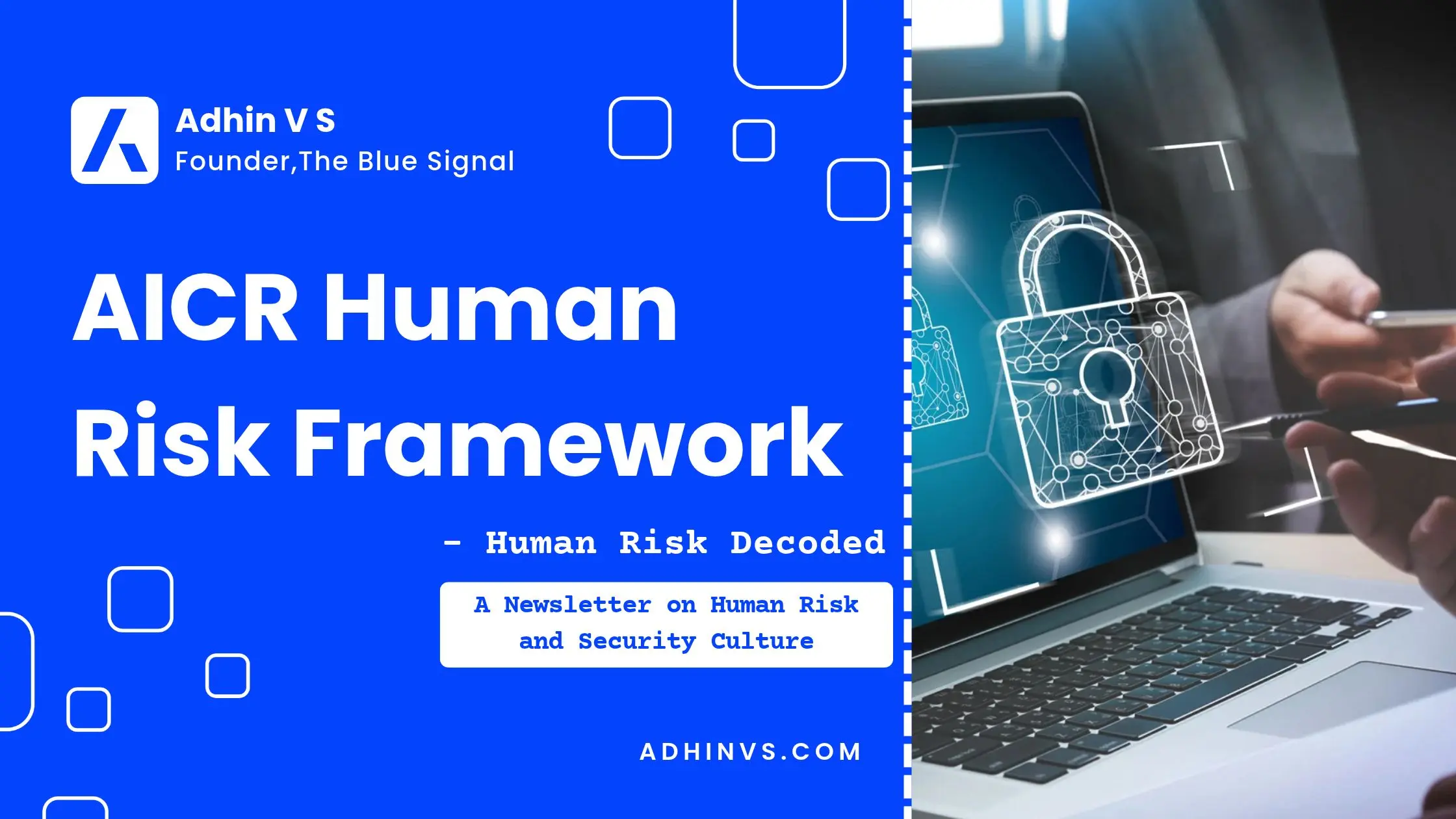
AICR is a connected framework for understanding and managing human risk in cybersecurity.
The name represents four responsibilities:
- Assess
- Influence
- Culture
- Reinforce
These four responsibilities help an organisation understand what is happening, improve how people make decisions, create better working conditions, and sustain secure behaviour over time.
AICR begins with a simple principle:
People are not the weakest link. Human risk emerges from the interaction between people and the conditions around them.
A person may make a risky decision because of a confusing process, an unrealistic deadline, an unavailable tool, an authority figure, fatigue, social pressure, or a well-designed manipulation attempt.
If an organisation only tells people to “be more careful,” it may miss the real cause.
Assess: understand before intervening
The first responsibility is to understand where human risk exists.
The Human Risk Assessment Framework looks at risk at the organisational level. It examines:
- Which workflows involve consequential decisions
- Which people or groups are exposed
- What controls already exist
- Where processes create friction
- Who owns the relevant conditions
- How mature the current practices are
- What evidence supports the conclusion
The assessment can examine areas such as access behaviour, social engineering, data handling, security fatigue, AI-generated deception, reporting culture, physical security, and overconfidence.
It also recognises that different groups face different risks. An executive, a privileged administrator, a finance approver, a remote worker, and a third-party vendor may all encounter different forms of pressure and authority.
Security Pulse works at the individual level.
It uses realistic and relevant situations to understand how someone makes a security decision. It can show whether a person needs more explanation, practice, confidence, or support.
Security Pulse is not meant to shame people or label them as secure or insecure. It is intended to help create a useful learning path.
Its principles are:
- Personalize the situation
- Unscript the scenarios so people practise the underlying principle
- Learn through feedback and retry
- Protect scoring integrity by separating skill, engagement, confidence, and context
- Evolve or erase by removing shame, guesswork, and unnecessary personal information
Influence: change how decisions happen
Awareness can tell someone that phishing exists.
Influence helps them make a better decision when a request appears familiar, urgent, or authoritative.
Security Influence 6E describes six parts of a useful learning experience:
- Expose people to realistic situations
- Explain why the situation feels believable
- Engage them in making a decision
- Empathize with the pressure they are experiencing
- Equip them with a practical response
- Engrain the principle so it can transfer to another situation
For example, an employee should not only learn that payment changes are risky. They should practise how to pause, verify through an independent route, challenge urgency, and communicate the delay professionally.
Two supporting models help with the explanation.
INDUCE–DECODE examines how influence builds momentum and how people can interrupt it.
A request may:
- Create an intention
- Appear normal
- Reduce doubt
- Create urgency
- Encourage commitment
- Extract information or value
The person can respond by detecting the signal, examining the situation, challenging the claim, opting out of the unsafe route, delaying action, and emerging with better understanding.
The Human Vulnerability Framework examines the path through which a situation affects behaviour.
It asks:
- Where did the path begin: Self, External, or System/process?
- Which opening was used: Attention, Reasoning, Routine, or Value?
- What widened the opening: Emotion, State, or Social conditions?
- What moved the person toward action: Push, Pull, Bind, Deceive, Disrupt, Blend, or Bypass?
This helps an organisation understand the event without turning the person into the problem.
Culture: make secure behaviour possible
Even the best training can fail when the workplace makes secure behaviour difficult.
Culture asks what happens when people need to pause, challenge authority, report uncertainty, or admit a mistake.
The ECHO Framework examines four areas:
Empathy Code
What made the action seem reasonable at that moment?
This includes workload, deadlines, fear, hierarchy, unclear rules, broken tools, and competing priorities.
Cultural Index
What actually becomes normal in the workplace?
The written policy may require reporting, while the experienced culture may punish people for slowing down or raising concerns.
Human Standard
Was the expected behaviour clear, possible, feasible, safe, and fairly accountable?
Before blaming someone, the organisation should ask whether the person had the knowledge, tools, access, time, permission, and support required to act securely.
Ownership Engine
Who is responsible for changing the situation?
A secure outcome may involve a behaviour owner, a condition owner, a control owner, and a learning owner. One accountable person must coordinate the actual change.
Reinforce: support the decision in real time
Security behaviour cannot depend entirely on memory.
People need practical support when they face uncertainty.
Reinforce includes continued learning, reporting, visibility, feedback, and tools that help people detect, verify, and decode situations while they are happening.
This could include:
- Email add-ins
- Browser extensions
- Collaboration assistants
- Verification hubs
- Approved contact sources
- Link and QR-code inspection
- Sensitive-action prompts
- Reporting and recovery channels
- Practice and retesting platforms
- Ownership and response tracking
A warning should not simply say that something is “safe” or “unsafe.” It should explain what requires attention, what can be verified, which trusted route to use, and what remains uncertain.
A tool can support the decision, but it cannot replace accountability. If the matter involves incomplete evidence, business approval, or incident response, it must reach the appropriate owner.
AICR is about better decisions
AICR does not aim to create perfect employees.
It aims to help people recognise risk, pause when necessary, verify important claims, ask for help, report uncertainty, and recover quickly when something goes wrong.
It also asks organisations to examine their own role.
Was the secure action clear?
Could the person realistically perform it?
Was the process usable under pressure?
Was it safe to challenge the request?
Did anyone respond when the concern was reported?
The goal is not to manage people through fear.
The goal is to understand the conditions in which decisions are made and improve those conditions so that secure behaviour becomes clearer, more practical, and more sustainable.
That is the purpose of AICR – Visit https://adhinvs.com/aicr-framework/ for more details
Assess what is happening. Influence how decisions are made. Build a culture where secure action is possible. Reinforce it through practical support and continuous learning.
A Personal Note
AICR is a framework I have developed through continuous study, observation, and practical work in human risk and behavioural security.
I am now looking for an opportunity to bring this knowledge into a corporate environment, contribute as part of an internal team, and learn from the everyday realities of organisational security.
I would value the opportunity to grow within an organisation that is committed to improving security behaviour, human risk management, and workplace culture.